And then all the sudden you’re home. And your life returns to its normal course; well, almost. You perceive it all differently now; it’s as though there’s a film over your eyes, or as if a film has lifted. I reallly didn’t think enough time had passed for this to be true but as it turns out I was gone longer, or more profoundly gone, than I had thought I was.
So the funny thing is that there appears to be a ritual of returning. I can’t decide if I do these things to overcome my culture shock or to wallow in it a bit longer. I’m one of those annoying people who’s like, well, in MEXICO, they do things THIS way, and when I was in MEXICO, I did THAT thing. I can hear myself doing it but can’t seem to contain it for the time being, which suggests to me it’s simply something I need to do, at least for a while.
There are other surprising ways in which coming home this time has been the same as last time. For example, I’ve listened to a lot of Silvio Rodríguez. The funny thing is he isn’t even Mexican. But he does sing in Spanish and is very, very depressing. If you looked in my fridge right now you’d see tortillas, beans and lots of jalapeños. I made a brief foray into the garlicky, Italianesque flavors I had been missing, but two days on I once again crave chile and lime with everything.
There are tradeoffs, naturally: being reunited with Phantom Limb, as I nicknamed my dog after the first week I spent without him. The house I live in is vacant except for me and P.L. and though I only have access to the smallest of three apartments, I’m insulated from the comings and goings of neighbors at least til the end of this month. I have commandeered the porch and its furniture, even though it technically pertains to one of the vacant apartments, and intend to make enough of a tradition of drinking my morning coffee there that the new occupants will assume the porch is part mine (hopefully disregarding that to get to it I have to climb out my bedroom window). The porch chairs and table were left by the previous tenants, and since they are upholstered in brown and aqua and match my bedroom I have decided they shall henceforth belong to me. Having a car and a bike to get around with isn’t all bad, and though it feels like someone is breathing on me at close range all day long, the humidity and the tree-ey-ness (oh dear lord, there must be a real word for that) make me feel enclosed, sort of cradled and protected. The exact opposite of the “región más transparente del aire”, as Humboldt nicknamed the Mexican plateau.
I’m still seeing the States with an outsider’s perspective, I think. Everybody seems so trashy, maybe because in the last few days I’ve made 1482 trips to the Harding’s on Howard for one thing or another. People speak ungrammatically with these threadbare voices completely spent by cigarettes and booze, and drag their obese bodies around atop irredeemably ugly shoes. And surrounding these bizarre lumbering creatures, everything made for their use and amusement is so sleek and abundant.
Except my friends, of course. My friends are immediate, genuine and careful around me when I've been away. They are sparkling and busy with any number of noble and clever pursuits. I have promised them I will come home soon.
Tuesday, July 10, 2007
Monday, June 18, 2007
why I'll never go native
Yesterday a golondrina flew into my classroom. A golondrina is a swallow; as so often happens with birds its name is much more lyrical in Spanish and better fits a tiny, airborne feathered thing. I had only ever seen them soaring and swooping, the sun glinting blue-black off their sleek backs, a flash of red belly during a particularly daring dive. I used to go to a bridge over the dwindling river to watch them flit back and forth whenever I felt homesick.
In Mexico it’s good luck to have a golondrina. People plant nests for them hoping they will fill them, and the birds will roost, then disappear, then return again and again. The golondrina, in Mexican folklore anyway, is thus a precious, restless little creature who, despite its wanderlust, never forgets its home.
(Perhaps you begin to understand why I have one tattooed on my arm.)
This one I didn’t recognize at first. Cowering on the floor of a dark room, its feathers dulled to gray. It seemed injured or paralyzed by fear, far from evoking the lyrical acrobatics I associate with the word -- and the bird -- golondrina. I stood dumb, not knowing what to do but unable to leave the little bird trapped in a corner under a table.
Luisa, one of the student assistants, came in. O, she said, una golondrina. Pobrecita, está atrapada. Levántala. Pick her up. It won’t bite me? I said. Luisa glanced at me, quizzically but too kindly to say anything, and stooped. She cradled the tiny bird in her hands and carried it out to the terrace, where she knelt down and opened her palms.
The bird rested there, closing its eyes, stretching over these two shiny black seeds a pale gray veil of the most delicate tissue. At that moment I wanted nothing more than to take it in my own hands and feel its diminutive heart palpitating against my fingers. For several seconds it seemed lulled by the fresh air and light. No vuela, Luisa said, disappointed. No, I said, it can fly. Gently I stroked its belly and it shuddered awake, took two tentative steps across Luisa’s hand and traced a graceful arc over the lip of the terrace and across the courtyard out of sight.
This morning on the bus, while I was abstracted and thinking about the golondrina, a tiny person perched on the seat next to mine. I couldn’t tell at first whether it was a man or a woman; he, or she, wore a black stocking cap and a white fleece jacket several sizes too big, in spite of the heat that already pressed in on us at nine in the morning. Out of the corner of my eye I could see a brown and leathery face, cured by sun and wind, and the broad, angular nose that betrays the indigenous here. After a moment this person spoke to me in a quiet tenor that further failed to resolve itself into male or female. ¿No hace como friyito? the voice said. No, I replied, I didn’t feel cold. Other passengers turned to look, perhaps wondering why someone would confide in me, a stranger, a foreigner. I mentally checked the location of my passport, my backpack, my camera, my wallet.
It was when a tiny, icy hand rested on top of mine where they lay in my lap that I realized she was a woman. I looked up into her face. Why are you so cold? I asked her. I don’t know, she said. Sometimes I think I don’t have any blood anymore. You must have some, otherwise you wouldn’t be here, I said and smiled, not really knowing what else to say.
She regarded me blankly. I studied her back. A life spent smiling had carved crow’s feet around her eyes, but they were ringed with a watery film as if she had recently been crying or indeed very ill. She told me she supposed it was natural for her to have no blood, since they took hers little by little each day in a hospital, four o’clock in the afternoon, four o’clock in the morning. I wasn’t sure to have understood her, so I made some general sympathetic comment and fell back into silence. A moment later, she announced bueno, aquí me bajo and shambled out of her seat. When she turned her back to walk down the aisle of the bus I realized the stocking cap concealed a bald head, and out of the top of the fleece jacket protruded the bones of an undernourished spine. Cancer, I thought. And she had tried to tell me, had given me chances to ask, and I had failed to hear.
I felt ashamed. How hard would it have been for me to trust such a small and defenseless person? How hard would it have been for me to take those cold, misshapen little hands and hold them in my warm ones for the duration of a bus ride? How hard could a tiny golondrina have bitten me before I set it free? What is it in me that flees this contact, this encounter? I know what to do and I yearn to do it, so why do I mistrust when I should love, and only realize it after?
My hands on my keyboard feel scalding hot, cursed. They are full of warmth and life if I could figure out how to share them.
Tuesday, June 12, 2007
and yet...
Further evidence that Querétaro is increasingly my second home: upon visiting Mexico City this weekend, three weeks into my time here, it dawned on me: I’m in Mexico for the summer. I was at the National Anthropology Museum, far from the home-away-from-home of my mundane, routine pursuits, watching it rain when this obvious realization finally clunked into place.
It occurs to me the word “home” has been cropping up with startling frequency in my writings lately.
Mexico City is a megalopolis, which essentially means two things to the casual traveler: 1.) everything that’s cheap elsewhere is exorbitantly priced because of the massive, war-zone-like distribution problems, and 2.) a lifetime wouldn’t be enough to see and do everything you can think up to see and do over the course of two days, so you have to save something for next time and resign yourself to sensory overload and exhaustion. For example, day one: ruins at Tenochtitlán in the morning, anthropology museum in the afternoon, followed by a night of mariachis, lasso tricks, folkloric dancing and cock fights, all enjoyed over a supper of roasted goat. Day two: Chapultepec (Mexico City’s question, if Central Park is New York’s answer to it), palace and home of Mexico’s six-year emperor, palace of fine arts, lunch at a café after which one of your favorite bands has named itself, and the National Museum of Art.
Here’s a fun game to play when you’re in Mexico: find the one weird thing wherever you are. No matter where you are and what you’re doing there’s always at least one thing in your environment that’s completely incongruous. You’re in the art museum looking at painting after 17th century painting of martyrs and Marys and suddenly there’s a kid in a wrestling mask. You’re in a shi-shi restaurant eating a buffet lunch Mexicans have prepared thinking it will appeal to Americans (featuring, for example, a substance almost but not quite entirely unlike mashed potatoes) when out of nowhere a man in a feathered headdress and loincloth barges in and starts blowing into a conch and whooping and whirling about. Times like these you don’t have to look too far for incongruities. Other times you have to dig a little deeper, but don’t worry, they’re there.
Another thing about Mexico: it’s baroque by nature. Baroque everywhere else went out of style a couple hundred years ago. Here, baroque is like energy: it doesn’t disappear, it merely changes form. The Palacio de Bellas Artes, a triumph my friends and companions had to drag me from kicking and screaming because I didn’t ever want to leave EVER, has all the grace and harmony and whimsy of my beloved art deco while still remaining summarily, consummately Mexican. If you visit the post office you’ll need to sit down after mailing your letter; the post office is breathtaking, and I am not even exaggerating.
I used to be ambivalent to Mexico City. After this weekend I really like it. Someone gave me a book of poetry. I took a picture of a fireman with his dog in the Zócalo. I got stalked by some strolling minstrels. I scratched the surface, and I will go back.
Monday, June 11, 2007
mexico reloaded
The funny thing about going back is how different everything isn’t. The things that surprised you the first time around, you expect them to be at least a little novel or disconcerting upon reentry, but they aren’t, you just kind of assume them again very quickly. I guess I thought I’d hear music I’d forgotten, taste flavors I’d left behind, and visit places I had neglected to miss and feel nostalgic, but really, being here hasn’t jogged my memory about much. This time around my recollections seem to have been remarkably faithful. Maybe I just haven’t stayed away long enough.
This is probably tied in with why I don’t have any over-arching, grandiose observations about Mexican culture or people for the time being. There are definitely some differences since last time I was here, but mostly in me: this time around I’m much less interested in meeting people I don’t know. I’m much more protective of my time, where and how I spend it and with whom. I’m less into playing paddleball with my heart and more invested in my job and my friendships. I’m more critical of what takes place in my environment. All this in some ways makes me more Mexican, more like the people who live out their lives here without assigning any special significance to living out their lives here.
On the other hand my current existence in Queretaro is much more provisional than before. Last time it seemed important to unpack, decorate, make a home for myself. I have yet to unpack. Although I’m staying the same amount of time at China’s this year as I did last, I don’t feel uncomfortable with the notion of living out of my suitcase for another month.
I don’t feel the urge to travel. In fact I’d love an excuse to stay home for a weekend. I’m traveling anyway, because it’s free and I’d be sorry later if I didn’t, but somewhere along the way my fever for the open road seems to have broken.
Don’t get me wrong – I’m very happy here. Despite missing my dog and my neighbor there’s no place I’d rather be, at least for a little while. At times I feel disappointed with myself for feeling so complacent, for not taking advantage of every single moment to pack them with unforgettable adventures. Given the life I’ve chosen to lead for the last ten years or so I would consider the loss of my sense of adventure as a sort of death.
But then I take such pleasure from the most mundane occurrences. La China lends me the car. I find my favorite shampoo on sale. I get paid in pesos. All of this is also an adventure of sorts, being a normal person in normal circumstances in a place that’s very much not normal for me. I start feeling like I could do it forever if I had to, although unlike last time I’m now fairly certain I don’t want to. I tell all this to China, my fellow Globe-Trotting International Person of Talent and Intrigue. She shrugs and says, yeah, because it’s your second home.
Congratulations. You’ve finally made it. You’re culturally integrated. You can tell because you feel so damn prosaic. That’s the irony I guess…home is where you hang your wonder.
Thursday, May 24, 2007
back to chamba
That's Mexican slang for work. Yup, I'm back in Queretaro, Mexico, my favorite slice of desert paradise. Although in some ways I feel I arrived before I actually got here.
The feeling of being back wasn't what I had expected. I helped my airplane seat-mate mortify his mother by pretending to be his gringa bride (it was sad...she actually almost cried when I turned out to be just another passenger) and found my way to my bus. So far so good, but when we started down the Distrito Federal's (that's Mexican for Mexico City) chaotic, labyrinthine streets I felt tired, annoyed and -- and here's the thing that really freaked me out -- not the least bit excited to be here.
Granted, I was physically exhausted, having worked through my last full day in the States and almost stayed up all night with Nayt and the neighbs in Chicago. I was also stressed from trying to move my trip up by 2 weeks and arranging to stay twice as long. But I was here now, shouldn't I be at least a little glad, excited, invigorated? Instead I felt hostile toward the pollution and litter, the traffic, the graffiti, the vatos locos thuggishly staring, trying to decide whether to talk me up or shake me down. I felt hostile toward Mexico in general, toward my own lack of plans for the afternoon. I resented my monster suitcase and having to carry it everywhere, having to buy a phone card to use the public telephone.
You must understand: I am never not excited to be in some far-flung land. Never.
I finally hit on it. As much as I loved being here the last time around, underneath the euphoria, the exhilaration, I was actually really sad. At the time I thought I had experienced the worst of my heartbreak, confusion, loneliness, grappling with the darkest portions of myself. Soon enough I would realize that the scariest and most painful part still awaited me. That sadness was all there, I just wasn't acknowledging it yet. Nonetheless it was the first thing I felt when I landed this time around.
When I got to Querétaro I had three phone numbers and no plans. I reached my future roommate and she chewed me out for not e-mailing her, then gave me directions to her family's (my adoptive familia's) house for lunch. I was welcomed with delighted hugs and a home-cooked feast. Later we had a party at the apartment with several of the people I've spent nearly a year missing, as well as some other welcome faces. The next day I saw all but a few of them, and since then I've managed to see all but two or three of my cuates (that's Mexican for buddies, güey).
In short, I'm in love with Querétaro all over again.
Monday, April 23, 2007
plain jane and juana plana
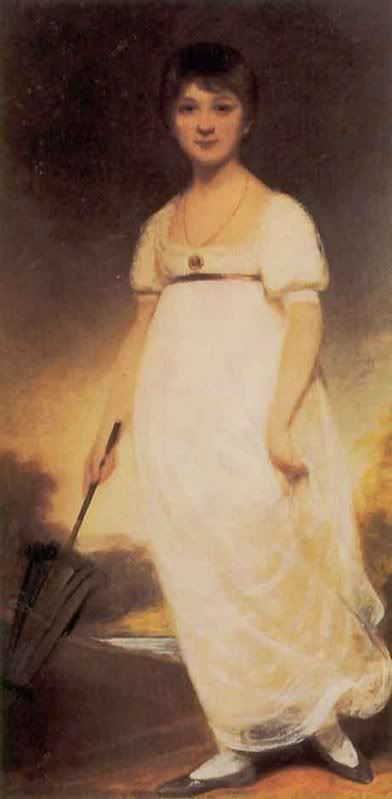
So, okay, maybe it wasn't the most disturbing thing in the news last week, but I did find the folderol surrounding the supposed Jane Austen portrait troubling. In case you didn't know, what was supposedly the only portrait of Brit Lit's sweetheart was to be auctioned at Christie's last week, its price set at a modest $800.000 USD.
It would have been worth a great deal more, of course, had anyone been able to prove it is indeed a painting of Jane Austen. It has been in possession of direct-line descendants of her brother Edward until now, the Rice family. Many compelling arguments exist to suggest that the subject of the Rice portrait is not our girl: the hair isn't dark or curly enough to match descriptions and other sketches of her, the dress wouldn't have come into fashion until she was in her 30's while this is clearly a study of an adolescent, there are no proper portraits of the other Austen children and no one in her family could have or would have afforded one, and so on. It's also compared unfavorably with her niece Cassandra's miniature of her.
Okay. Maybe it isn't her. So far I'm on board. Until they interview an art scholar on NPR and he says that the girl in the portrait is simply too pretty to be Jane Austen.
Say what?!
So I decide to dig a little deeper, and I go to a blog dedicated to Jane Austen, and I read a bunch of Austenites arguing --quite rightly -- that it's unreasonable for us to demand of Jane Austen that she be remembered as beautiful, as if her litererary accomplishments were superfluous to the achievement of being physically attractive. One of them says: "The impulse is not terrible. We Janeites want to believe that Jane Austen was a pretty woman; it is the most natural instinct in the world. However, as Jane herself said, she did not write for such dull elves as have not a good imagination themselves. Can’t we accept Cassandra’s portrait, and just imagine that face lit by humor and animation and color? Are we, as Janeites, such pictures of intellectual poverty?"
My qualms with this whole thing are two: First of all, the discussion, even by supposed fanatics of Austen's writings, revolves ceaselessly around her physical characteristics and fashion sense, which I'm sure whatever's left of her is tittering about behind a pretty little skeleton hand.
Secondly, and more importantly, at what point is it intellectual poverty on our part to conclude that because of her incredible talent, she must needs have been homely? Are we still so far from fathoming that a bright, talented woman might also have turned out to be beautiful? That looks and brains aren't necessarily mutually exclusive? Mr. Art-Radio Scholar said that no one in Austen's time could have written so authoritatively about the experience of homely, rural, modest, practical and resourceful girls unless she was herself one of them. I couldn't disagree more: all it takes is a measure of empathy and imagination.
Miguel de Cervantes was neither a choleric nobleman nor a phlegmatic fatso, and his Ingenioso Hidalgo Don Quixote de la Mancha has over 400 characters, many of them splendidly drawn. His physical appearance isn't once thought to have had a bearing on his craft, other than that he couldn't have written his novel with his right hand, as it had already been chopped off. To use a more contemporary example, Federico Garcia Lorca was extraordinarily easy on the eyes but that didn't stop him from writing about alienation and the lot of homely women in La casa de Bernarda Alba.
Adrienne Rich observes in When We Dead Reawaken: Writing as Re-Vision how deeply we've bought into the notion that, in order to be an author, one must be deeply afflicted somehow, whether because of alcoholism or physical ugliness, handicap or misanthropy. So much had she herself believed this, that she felt ashamed of wanting a normal life and poetry at the same time, until she learned to see her art as growing something instead of destroying. Is it so unthinkable that Jane Austen could write good novels without being sad about being plain, or that as a pretty girl with an inquisitive mind she might have cared about the experience of others enough to inform herself and write about it?
Sor Juana Inés de la Cruz, the 17th century Mexican nun, was by all accounts an exceptionally beautiful woman. Her works still challenge readers today, but she's still called "the 10th muse" by some scholars. She wasn't a muse at all, the object of someone else's inspiration, but a poet in her own right. About her own portrait, overly flattering in her opinion, she writes:
This, that you see, this colored treachery,
which, by displaying all the charms of art,
with those false syllogisms of its hues
deceptively subverts the sense of sight;
this, in which false praise has vainly sought
to shun the horrors of the passing years,
and conquering of time the cruelty,
to overcome age and oblivion's might,
is a vain artifice cautiously wrought,
is a fragile bloom caught by the wind,
is, to ward off fate, pure uselessness;
is a weakened zeal, and, rightly seen,
is corpse, is dust, is gloom, is nothingness.
Her beauty detracts nothing from her genius, nor from her modesty, though she struggled in life to undermine it, chopping her hair, donning a habit and, at intervals, rejecting human contact. In this way, physical beauty became her affliction and a recurring theme in her literature.
The startling thing for me about this whole discussion isn't the who's-hot-and-who's-not aspect of it, but the tapestry of preconceived notions it reveals about art and womanhood and creativity. I don't really care whether Jane Austen was beautiful, but it alarms me that someone - a scholarly someone at that - argues that she couldn't have been beautiful because she wrote good books. Had Jane Austen known Sor Juana, I'm inclined to think they would have painted the town together, talking books and breaking hearts.


Wednesday, April 18, 2007
Se llama Rigoberta Menchú y así me nació la conciencia

So just when you think you can't possibly fight The Man any harder...
you meet The Woman.
Subscribe to:
Posts (Atom)